Welcome back to Flexibility Is Freedom!
This month, I completed my niche research and selected my next two websites. 😎
(keep reading as I'll discuss which ones and why I picked them)
As a result, this month's income report is a massive one - covering everything from niche research to keyword research to content planning.
So grab yourself a cup of coffee and let's get started!
Key Metrics
- Revenue: $320 (+57% MoM, -48% YoY)
- Sessions: 2,536 (+9% MoM)
- RPM: $126 (+45% MoM)
- Amazon Risk: 52% (down from 64% last month)
First, here's a run-down of March performance.
Revenue improved MoM but is still way down YoY and relative to Q4 2020.
Sessions remained about the same so it was primarily driven by higher RPMs.
Even so, it's nice to see an uptick, especially since I spent 0% of my time on it this month.
Going forward, I'll likely dedicate 5-10% of my time to optimize content, publish 1-2 posts a month, and reinvest the cash flow into backlinks via an agency like SEOButler.
This way, I can keep the website active while I work on setting up new ones.
Niche Research: Revisited & Remastered 🏆
Last month, I touched on niche research and a couple different ways to brainstorm ideas.
This month, I used an excellent framework from The Authority Site Sytem 3.0 to further define and refine my niche research and niche selection process.
Overall, the framework boils down to three key factors:
- Traffic: can you build (organic) traffic with a brand new website?
- Monetization: how well can you monetize this traffic?
- Passion: what is your level of interest and degree of commitment?
Now, let's discuss each of these factors.
1. The "Trifecta" of Traffic, Monetization, and Passion
I call it the "trifecta" (no Illuminati comments, please) because you need all three to have the best chance for success.
It's like the TriForce in Legend of Zelda!
Traffic
Obviously, you need visitors on your website.
The standard methodology is to look for "high traffic, low competition" keywords.

The real question, however, is a question of tradeoffs.
How low are you willing to go in terms of search volume to find low competition (and presumably easier-to-rank-for) keywords?
Some approaches, like the Avalanche Theory on Builder Society, recommend going extremely low (0-10 estimated searches a month for a new website 🤔).
However, there really isn't a one-size-fits-all approach. Traffic analysis should be predicated on the value of this traffic (as determined by monetization options or proxied by the cost per click).
If there are high-paying, high-converting, and sustainable monetization options, I'd feel pretty comfortable going for lower volume keywords (50-100).
But if there are few monetization options and/or Amazon is the only game in town, I'd be much more disciplined about keyword volume.
Next, we need to evaluate keyword difficulty and this is the most difficult step.
As I mentioned earlier, the general principle (an assumption, really) is that lower volume keywords will be easier to win (due to less competition for them).
However, if I've learned anything from my experience (within the context of the broader health & fitness industry), it's that you must be spatially aware of your high domain authority (DR/DA) competitors.
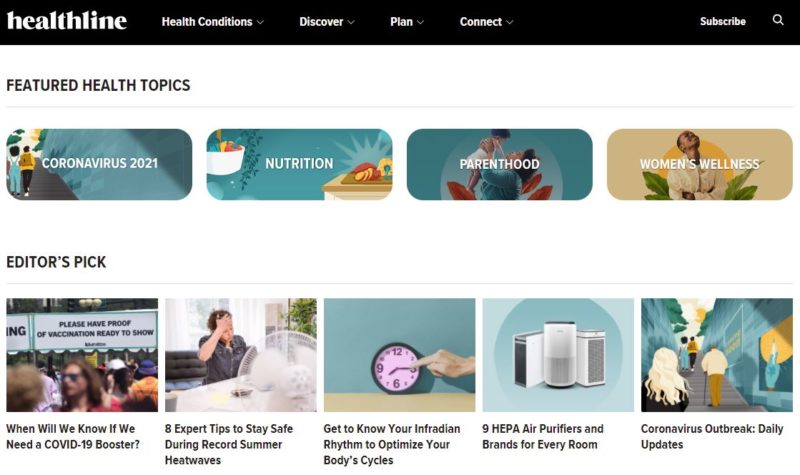
There's a point at which a website / brand completely dominates their industry (e.g. healthline.com in health, thesprucepets.com in pets) that it creates its own field of gravity.
(gravity, here, being an analogy for domain authority)
In my experience, a high DR/DA competitor will naturally attract keywords into its "orbit", even if its corresponding page is not very relevant for the keyword.
This means position #1-3 or even #1-5 might be permanently unavailable for smaller websites.
So even if you produce the best, most relevant, and most user-friendly content, you still cannot overcome the huge difference in domain authority.
In short, evaluating keyword difficulty requires excellent judgment and niche experience.
Monetization
The next factor, and the most important, is the quality of monetization options.
I learned the hard way about the risk of relying on a single merchant (Amazon) who can singlehandly cut their commission rates and/or restructure their program.
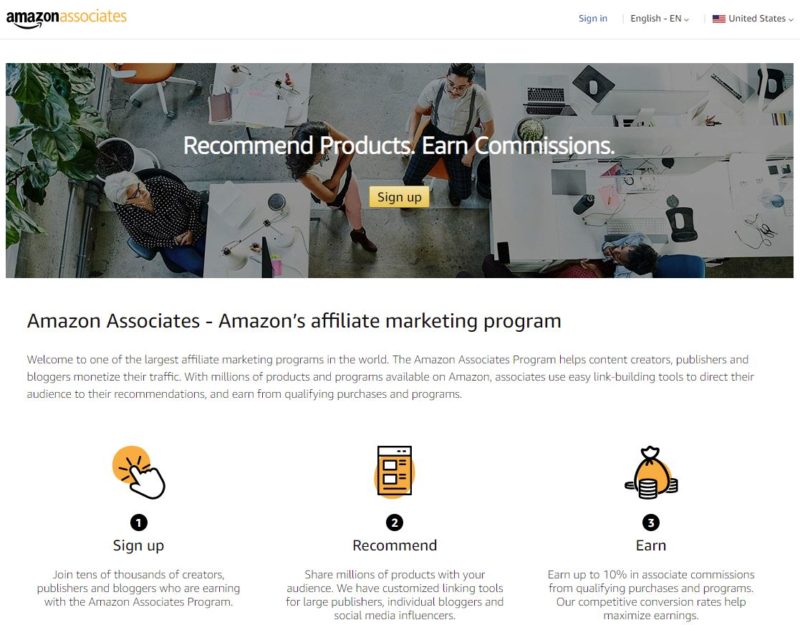
(Amazon Europe already rolled out a modified affiliate program last year 🤔)
It's definitely one of the downsides of affiliate marketing (total lack of control).
That's why I spent most of my time during niche research evaluating the merchants, affiliate programs, and overall industry sustainability.
Once again, it's usually a game of tradeoffs.
The best merchants tend to have the worst affiliate programs. Case in point:
- Amazon, Wal-Mart, Target: usually 1-3%
- Sephora: 3.75% (after 25% Skimlinks fee)
- BestBuy: 0.5%
But... if they have a high conversion rate (like Amazon: 15-20% in my experience), then overall earnings per hundred clicks (EPC) might be reasonable.
For example, I had an average EPC of $10-12 with Amazon (post April 2020 rate cut) compared to only $2 with Sephora and $4 with Ulta Beauty.
However, with some private merchants, I regularly achieved $100+ EPC. 😎
For my new projects, I'm looking for a good balance between:
- Merchant Quality: would I feel comfortable buying from them?
- Affiliate Program Quality: do they value their affiliate partners?
- Number of Options: are there fallbacks in case of problems?
- Sustainability: can they afford to pay these commission rates long-term?
A quick-and-dirty way to "feel out" the affiliate programs is to check where top competitors are sending their traffic in Ahrefs Linked Domains.
Passion
Finally, the last factor is passion (or at the very least, a strong interest).
You'll be more likely to persevere through challenges (and the lack of short-term results) when you're truly passionate about a topic.
With my first website, I definitely checked the box on passion and in retrospect, I would 100% agree that it's helped me keep going after every obstacle.
If it were a topic that I was less interested in, I may have given up much earlier.
Now, one of the challenges that many people face is they don't have a "passion" or perhaps they have too many passions to choose from.
That's why I think you only need to have a "strong interest" to start with, as you'll eventually develop a passion (or a better understanding) of your niche over time.
On the other hand, just because you have a passion for something, doesn't mean it'll be profitable if you can't build organic traffic and monetize well (the first two factors).
2. My Process Today vs. 2 Years Ago
Next, I'll compare my niche selection process today vs. 2+ years ago.
When I first started, I used more-or-less the same framework to "find" my niche. Although I must say I was very biased towards skincare due to my interest.
In comparison, I put much more emphasis on traffic and especially monetization during this recent round of niche selection, and less so on passion.
In other words, my process focused on maximizing traffic/monetization potential, subject to a minimum level of "passion".
And this led me to pick the following niches...
3. My Final Niche Selections (and why)
Now, I'll finally talk about my two niche selections.
However, I won't be releasing the domain names this time, partly to keep their backlink profiles separate but also to prevent any competitive disadvantage from doing so (if any).
My first pick is Pets (I know, big surprise! 🤣).
It's obviously a huge industry with a ton of competition from institutional websites (like TheSprucePets), YouTubers, Instagramers, and affiliate marketers.
I will be targeting a specific subset of pets (not dogs or cats) that I think is attractive from a traffic and monetization perspective:
- Traffic: I see a good opportunity to build a low-to-medium size website given the number of low DR competitors that are ranking for commercial keywords. In addition, there's a variety of informational and commercial queries (multiple ways to win) and a strong community (Facebook groups, Pinterest, YouTube, etc.) which opens the door for social media traffic.
- Monetization: the crux of this niche lies in monetization. Amazon pays 3% but Chewy.com pays $15 on new customer orders (any size). In addition, by using one of my plugins, I can obtain a special $20 CPA for Chewy.com. Assuming Chewy converts at only 1% (remember, Amazon is 15-20%), EPC would be $20 or twice what I'm getting with Amazon in the skincare niche (which is actually more profitable because luxury beauty pays 10%). I think Chewy could realistically convert at 2-4% which would be $40-80 EPC from a well-established brand - an extremely attractive proposition. Side note: Skimlinks network data shows Chewy converts at 35% - not sure if that data is skewed because it sounds a little too high to me.
Now, here are the major risks that I've identified:
- Competition: while subsets of the pet industry are less competitive, there are many "broad-level" competitors such as TheSprucePets or PetMD that might be (or turn into) the "healthlines" of this industry. In other words, they become so dominant that they naturally outrank you for less relevant keywords, even if they're not intentionally trying to.
- Proximity to E.A.T. Issues: ever since Medic Update in 2018, E.A.T. has been a hot topic when it comes to YMYL subjects - health, legal, finance, and more. Even if Google can't compare one medical degree to another, there's no doubt in my mind that YMYL requires a "special sauce" to rank well. Pets is usually not associated with YMYL, however, there are many pet topics that center around pet health, such as what to feed your pet, what to do if your pet shows certain symptoms, etc. These are really medical queries so does Google treat them with the same E.A.T. rules? If so, do authors have to be veterinarians, for example? (currently, this is not the case based on what I'm seeing in the SERPs but this may change in the future)
- Single Merchant Risk & Sustainability: the single point of failure for this niche is the complete reliance on Chewy.com. Yes, I know I said that you need multiple merchants (and I have a better example in my second niche). Here, I'm comfortable with the fact that we are building off of Chewy.com given their quality and product selection. I recognize that their program is NOT built for long-term sustainability (they lose money on most orders with a flat rate commission), but for short-term growth. That's why I plan to hold this asset for a shorter period of time and exit in 18-24 months.
Overall, my thesis is to build ~5,000-10,000 sessions a month of traffic from a mix of informational and commercial keywords, monetize (and optimize) with Chewy.com in the form of text links, buttons, sidebar banners, and pop-ups, and exit in 2 years.
With a flat rate program, it opens up interesting opportunities in lower price items so you can promote the lowest barrier, highest converting offers to your audience, since you make the same $20 CPA whether they buy $10 or $100.
Here's a simple downside and upside scenario:
- Traffic: 2,500 - 10,000
- CTR (to Chewy.com): 15% - 30%
- Conversion Rate: 2% - 5%
- EPC (Calculated): $20 - $100
- Revenue (Based on Previous Inputs): $150 - $3,000
- Exit Multiple (on Monthly Revenue): 25x - 35x
- Exit Price: $3,750 - $105,000
In addition, I believe my assumptions are very conservative:
- Traffic: I've identified many competitors with Ahrefs estimated traffic of 2,000-10,000. In my experience, Ahrefs is very conservative and underestimates by 5-10x. This is especially true for smaller websites as they just don't have enough data points.
- CTR: I've achieved 50-70%+ CTR for my best posts in the skincare niche. Hitting 15-30% CTR should be a reasonable target.
- Conversion Rate: how well Chewy converts is a key factor. Based on their website, product selection, checkout process, and brand recognition, I believe they will convert very well (Skimlinks says 35% but I think more like 2-4% or single digits).
- Exit Multiples: this is subject to change but the market is trending upwards as more institutional buyers (like PE funds) acquire online businesses, according to Empire Flippers' 2021 State of the Industry Report.
Now, onto my second pick: VPNs.
This one is pretty interesting. I knew that the monetization options were good so it was more a question of finding the right angle to build targeted traffic.
When you have good affiliate programs, it's bound to attract a ton of competition (e.g. hosting, SaaS, mattresses, credit cards, travel, etc.).
If you can find a creative angle or alternative traffic source (YouTube, Pinterest), you might be able to avoid the competition while still monetizing relatively well:
- Traffic: the VPN "niche" is extremely competitive. Any keyword with "VPN" in it is likely impossible for a brand new website. Massive technology publishers like TechRadar, Tom's Guide, CNET, etc. dominate the SERP along with a few niche-specific ones like VPN Mentor, Restore Privacy, etc. However, I've identified a subniche that is pretty attractive with low DR competitors on Page 1. The main strategy is targeting keywords that occur much earlier in the purchase journey (lower conversion rates but less competition). These are informational queries like "how to", "what is", etc. instead of "best", "vs", and "review". My main task (after growing traffic) will be optimizing pages to drive incremental improvements in conversions (CRO).
- Monetization: as I mentioned, VPN payouts are good (maybe not as good as hosting or mattresses, but still good). This is a natural reflection of the VPN business model - high fixed costs from maintaining or renting servers plus an IT and support team, but virtually zero marginal cost from a new customer (just like a cell phone provider). That means each new subscription is almost 100% margin which is why VPN providers are happy to pay high commissions for customer acquisition (sales). I've found that the industry standard is 100% commission rate on monthly plans and 40% commission rate on 1-year and 2-year plans. For example, ExpressVPN pays $13 on monthly plans (100%), $22 on 6-month plans (37%) and $36 on 1-year plans (36%) while NordVPN pays 100% on monthly plans, 40% on 6-month or longer plans, and 30% on renewal plans.
Like before, here are the major risks that I'm concerned about:
- Conversion Rate: I believe I'll be able to grow traffic, but how well that traffic converts, both on my website (CTR) and at the merchant (CR) is unknown. Building content for the Top of the Funnel (ToFu) and Middle of the Funnel (MoFu) is a new experience for me so I have no idea how well it might go. This is why my top priority after traffic is optimizing my website template, page layout, and content, to drive up the conversion rate. Other relevant tactics for ToFu and MoFu content is to engage and retain visitors with an email list, push notifications, and/or social media. That way, you can re-target them with product offers and discounts in the future when they might be more ready to buy.
- Legal: I don't think this will be a significant risk but when it comes to VPNs and other privacy tools, there may be legal requirements, disclosures, or related liabilities. I've taken the time to make sure my privacy policy and terms & conditions are updated, but I don't exactly have a legal team like the big VPN companies to handle this stuff.
Now, unlike my skincare website and the pets niche, I don't see this one being affected by any E.A.T. or YMYL related issues, which is good for my overall portfolio.
I also like that there's a healthy degree of merchants, excellent affiliate programs, and I believe current commission rates will be sustainable for the long-term.
Overall, my thesis is to build ~10,000-20,000 sessions of traffic in 24-36 months from primarily informational queries and monetize with VPN products in text links, buttons, sidebar banners, popups, emails, and more.
Unlike the pets niche (namely, its reliance on Chewy), I'm not as concerned about exiting quickly. I'd be fine to hold this asset for 2-4+ years but will consider selling it depending on market valuations and my own personal needs.
Here's a simple downside and upside scenario:
- Traffic: 5,000 - 20,000
- CTR (to VPNs): 10% - 30%
- Conversion Rate: 1% - 3%
- Payouts (using ExpressVPN as example): $13 (1-month) - $36 (1-year)
- EPC (Calculated): $13-39 (all 1-month plans), $36-108 (all 1-year plans)
- Revenue (Based on Previous Inputs): $65-180 (downside), $2,340-$6,480 (upside)
- Exit Multiple (on Monthly Revenue): 30x - 40x
- Exit Price: ~$2,000-$5,400 (downside), $93,600-$259,200 (upside)
Here's my thinking behind these assumptions:
- Traffic: since I'm going after info keywords, I think I can build a greater level of traffic, especially considering the variety of queries and geographical possibilities. My holding period is also longer which gives me more time to reach my traffic goals.
- CTR: I'm honestly not sure what CTR will be (and this is a huge driver). Regardless, I will be continuously optimizing it and I think 30% is a reasonable upper limit, given the informational nature of my target keywords (ToFu, MoFu).
- Conversion Rate: again, I'll need to obtain real-world data on different merchants. Network data from Skimlinks suggests a 4% CR for ExpressVPN, 3.2% for Surfshark, and 1.4% for NordVPN. If true, clearly ExpressVPN is the industry leader here.
- Payouts: this largely depends on what plan users choose. Users can also cancel their plan within 30 days for free (no sale, no commission). I would bet that most users go with a monthly plan, even though annual plans are cheaper on a per month basis.
- Exit Multiples: I revised multiples upwards because this type of business should fetch far more than a typical Amazon affiliate website due to the monetization quality, as well as diversity of merchants (unlike pets, which was 100% focused on Chewy). VPNs are a hot space, given how hard it is to get traffic there, so there might be buyers that want an established domain to pump additional capital and resources into it.
That's it for the niche research and niche selection process. I'm extremely relieved to have picked my two niches and it definitely took a very long time.
I was originally going to spend all of March on niche research but I wrapped up early and have started building one of them already.
I also wanted to discuss additional topics in this month's income report, but because it's gotten a lot longer than I intended, I will save those for next month.
My next steps are to setup the first website, publish content and build a v1.0, get approved by the affiliate networks and merchants, run an Adwords fishing campaign to validate search volume for my target keyword, and then re-evaluate from there.
To Flexibility and Freedom,
Tom
Happy Holidays! 🎄🎅🎁
We are finally at the end of 2020 and that alone is an achievement.
Personally, I am cautiously optimistic about the future outlook as vaccines are distributed around the world, however, I wouldn't count on a quick "back-to-normal" in 2021 yet.
Overall, the last month of 2020 was a disastrous disappointment for my website, primarily due to Google's last-minute surprise, the December 2020 Core Update.
This algorithm update was reported to be both "broad" and "big" - impacting many sectors and producing huge gains/losses from 10% to over 100% (source: Search Engine Journal).
In this month's income report, I'll discuss the impact of the December 2020 Core Update, my suspicions & theories on what caused it, and the steps I've taken or will be taking in the next few months to fix these problems.
Key Metrics
- Revenue: $329 (-71% MoM, +56% YoY)
- Sessions: 3,125 (-70% MoM)
- RPM: $105 (-3% MoM)
- Amazon Risk*: 50% (up from 39% last month)
December 2020 Core Update
Around December 4, 2020, Google released a broad core algorithm update.
Here's how it went down:
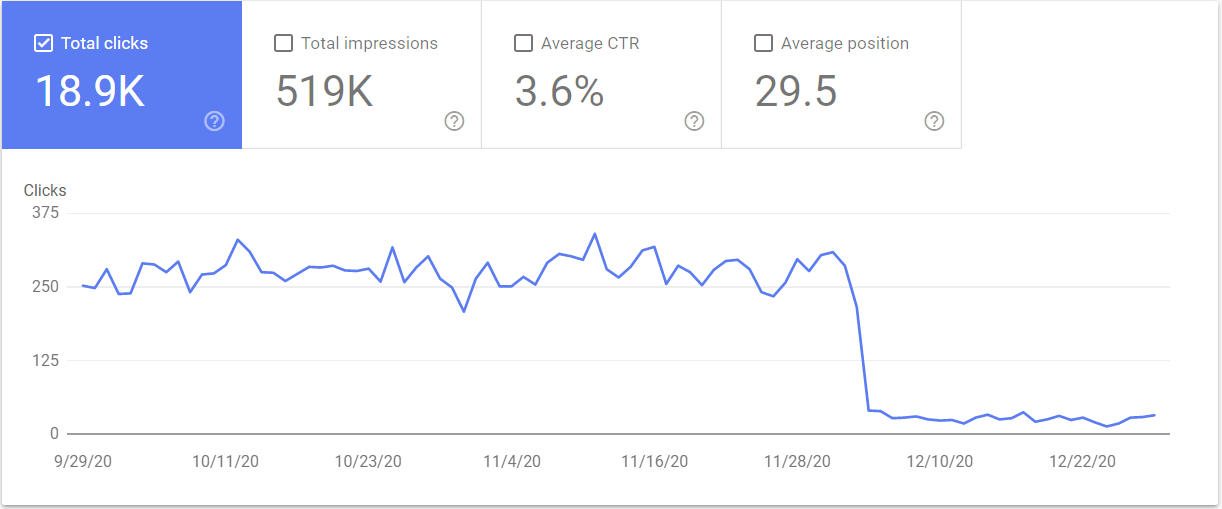
Yikes!! 😥😥😥
This time, the damage was even worse than the September 2019 Core Update (-40% traffic).
Clearly, something is not working...
Possible Reasons for An Algorithmic Penalty and Associated "Fixes"
1. Technical Issues
The first possibility is that I have one or more technical issues on my website.
Technical issues include the page speed, server status, robots.txt, redirections (301), etc.
In general, it's the infrastructure & software configuration of your website (such as plugins).
A slow website may contribute to the overall problem of low traffic or low rankings.
However, I don't think the algorithmic penalty was triggered by a technical issue like page speed or plugin configuration. That's because they're usually smaller factors that don't, on their own, result in a massive decrease in traffic.
But just to be safe, I've taken steps to eliminate any "technical difficulties":
1a. Cloudways
I decided to migrate my website to Cloudways (managed hosting) ahead of schedule.
As I mentioned in last month's income report, I've noticed 5xx server level errors with SiteGround and Google Search Console even sent me a warning about it once!
(strangely, I never had 5xx errors at Bluehost, which is owned by EIG - best known for consolidating hosting companies and turning them into garbage 🤔).
Anyways, it was definitely a good idea to switch and it wasn't even that expensive! ($10/mo with no contract at Cloudways vs. $5.95/mo with 36-month contract at SiteGround)
While my page speed has not changed dramatically, the overall uptime % has been better (no downtime at all yet - I use Better Uptime to monitor my website every 30 seconds).
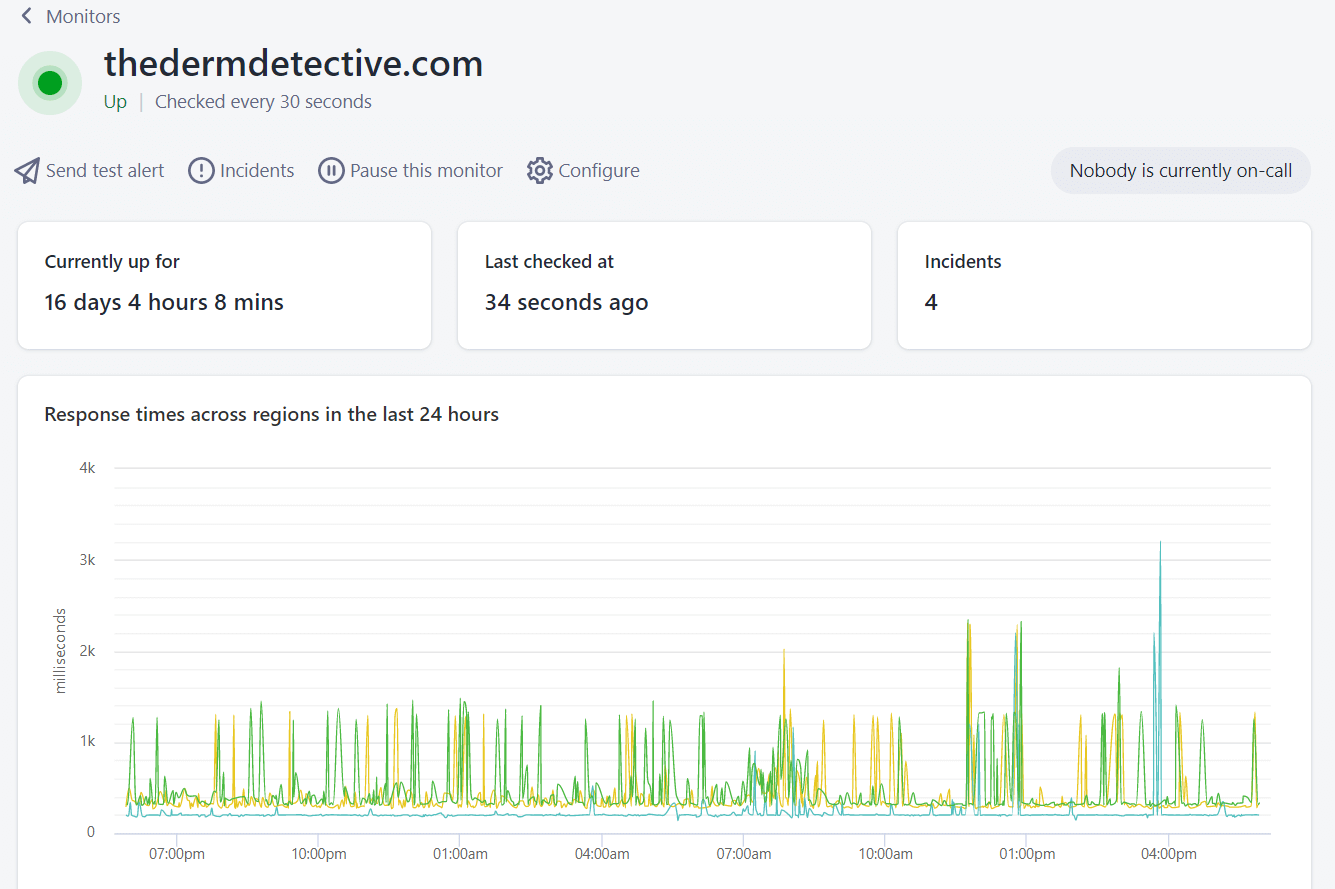
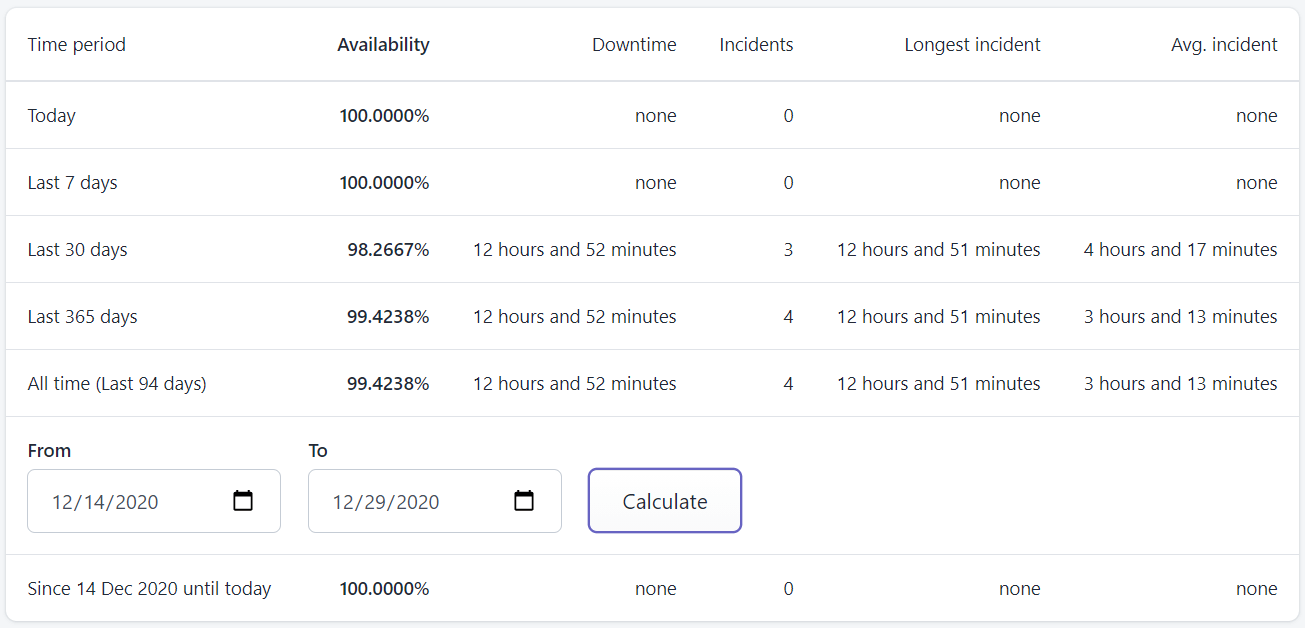
In addition, the WordPress dashboard feels faster and more responsive which reduces the time that I spend writing and editing posts (well worth the money!).
1b. Redirections (301 to 410)
During 2020, I made a few changes in content strategy.
After the Amazon Associates commission rate fiasco back in April, I decided to remove the majority of my "vs" and "review" posts in the scar treatment category, because:
- the commission rates for these products went from 6 -> 3% or 4.5 -> 1%
- the click-through-rate was very low (10-30%), and
- I needed to convert them from an Elementor page into a normal WordPress post as I was breaking up with Elementor (it's not you, it's me) and it just wasn't worth the time.
When you remove a post, it's good practice to leave behind instructions to tell search engines why it was deleted and if applicable, what page they should visit instead. It's like leaving your new address at your old place so you can receive any mail that you didn't change the address for.
The online equivalent is 3xx redirections (301, 302, 307) or 4xx client errors (404, 410, 451).
You can check out the full list of HTTP status codes on Wikipedia.
When I deleted my posts, I put up a 301 redirect from the deleted post to a relevant post, to preserve any traffic that I might get and any links pointing to that post.
Now, I'm thinking that maybe I overdid the number of 301 redirect's and Google is either getting confused or perhaps even penalizing my website (I doubt it, but you never know).
Given that these 301's do not provide significant value in terms of traffic or links anymore, I've decided to convert all of them into 410's (page intentionally removed).
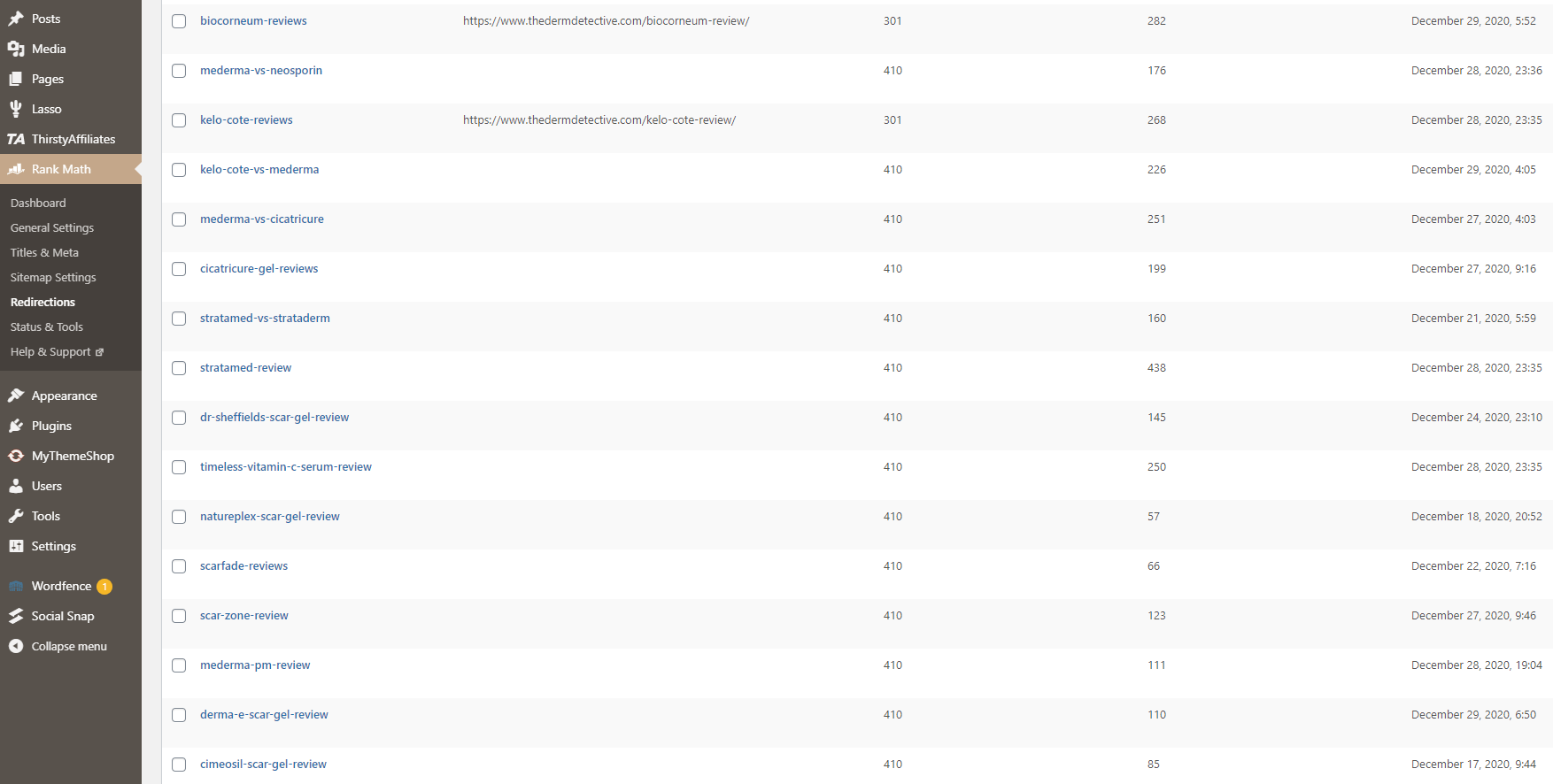
The 410 status code tells Google that your page is gone forever which discourages Googlebot from ever returning to recrawl the URL.
It essentially erases the URL from Google's index and is a cleaner solution than the 301 which says the page has been permanently moved to another URL.
2. Content Issues
The second possibility is that I have one or more content issues on my website.
Normally, I don't think "bad content" per se could ever trigger a site-wide downgrade, unless it's really overdone and all your content is "spun" (created using AI or other automated methods), plagiarized, or extremely "thin" (low word count).
If your content is "bad" (according to Google), then you simply won't rank well. 🤣
However, I've had a few posts ranking really well (that maintained their rankings) for many months before this recent update, so I don't think content was the main problem.
But to be safe, I've taken measures to improve the overall quality of my content portfolio, not just individual posts.
2a. "Thin" Content
The first step was to remove any "thin" content (typically 500 words or less).

While I never intended to create "thin" content, I did have a number of review posts that were pulled out of my best articles - my original thinking was that I could start the journey towards ranking for the review keywords without any additional effort.
I monitored my progress using a rank tracker and upgraded the article in the future when it got closer to page 1. For the most part, these posts ranked pretty well on their own, even though they were technically "cut and paste" duplicated content.
(however, a scenario like this doesn't trigger Google's "duplicate content" penalty. You'll know because your post will be hidden from search results by the duplicate content filter)
Anyways, I decided to prune this type of content from my portfolio and serve a 410 code instead. I've learned that "review" keywords are usually not worth the investment either, because:
- It's extremely hard to rank #1 organic for "[brand / product] review" - page 1 is typically full of user-generated review pages from Amazon, retailers like Wal-Mart, specialty retailers like Sephora/Ulta, review aggregators like Influenster, high domain authority review websites like WireCutter, and industry/niche blogs at the bottom.
- The conversion rate on "review" posts is much lower than "best" posts.
Before removing each post, I checked if it received significant clicks or impressions, the estimated keyword volume, and the competitors on page 1, before making a final decision.
2b. Content Simplification (Lasso)
The second step was to reconsider my approach to content creation.
While I'm personally in favor of long-form content (such as this blog post), I recognize that 90% of users are looking for short-form content like lists, infographics, and bullet points, the types of content that you can consume very quickly or skim through.
Unfortunately, it's a long-term trend as people develop shorter and shorter attention spans.
(as we can observe with the popularity of TikTok, for example).
Anyways, I've decided to use a different content layout for my "best" posts. My previous template was very good from a conversion perspective, but it required a lot of manual formatting.
This month, I stumbled across Lasso which inserts well-designed product boxes (called "displays") into my content. Here's an example:
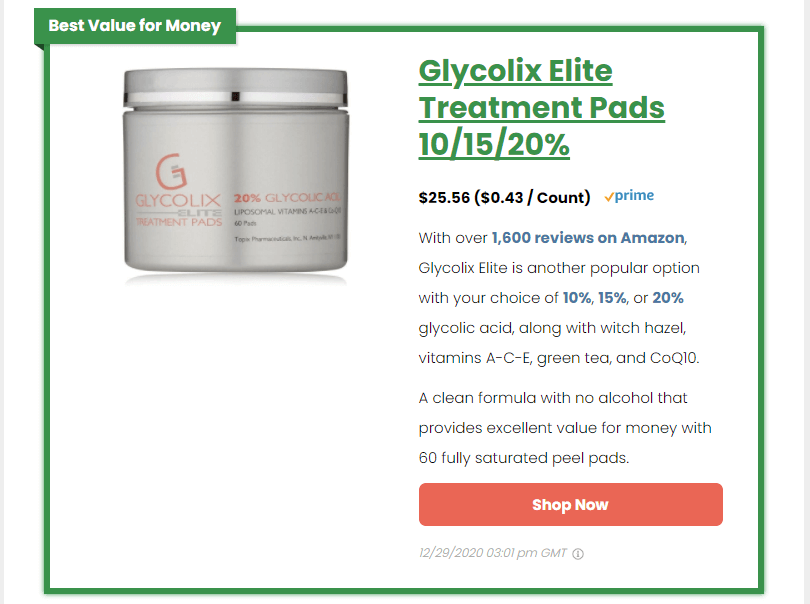
I really like the design - it's very clean & simple which should be good for conversions - and it saves me a lot of time on manual formatting and link insertions.
However, I still have to manually insert elements like the product title, product image, banner text (in the ribbon), product description, and affiliate link. For Amazon products, some of these elements are pulled automatically using the API (like the current price).
Lasso is a bit expensive, though, at $19/mo ($190/yr), but after speaking to the founder via email, I'm pretty bullish on the product and their roadmap of future features (like comparison tables).
I also stopped using Geni.us which saves me $9/mo - so Lasso is like $10/mo net.
It bridges the gap between Amazon Affiliate for WordPress (AAWP) and ThirstyAffiliates (TA), both of which I've used in the past.
AAWP produces amazing comparison tables and product boxes but only supports Amazon.
TA supports non-Amazon links but doesn't produce any type of product tables.
With the Lasso displays, I see opportunities to recommend products within non-commercial content like tutorials and guides as well.
When you're explaining how to solve a problem, you might recommend a product that you like, and instead of using a plain text link, you could drop a stylish Lasso display.
2c. Content Optimization (Frase)
Last month, I bought a lifetime deal for Frase.io, a content research and on-page SEO tool.
I'm currently using it to "polish" my completed posts by adding keywords or phrases that my competitors are using but I'm not.
Frase scrapes the top 20 results for a target keyword, runs it through their proprietary algorithm, and produces a report of topics along with a topic score.
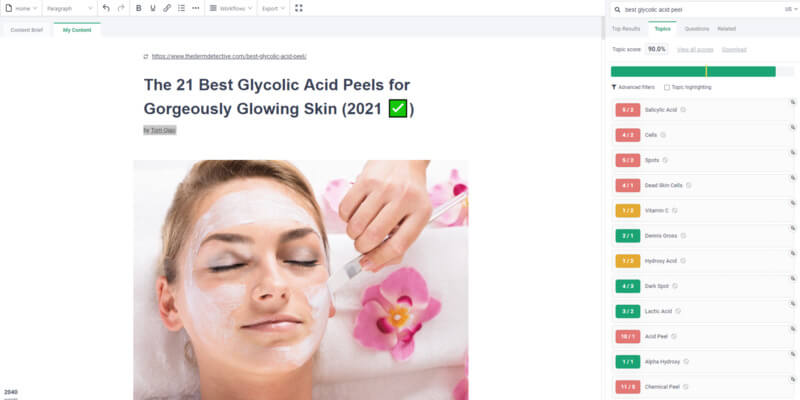
While Frase has many features, I mainly look at the topic score to make sure I've covered most of the relevant topics.
Frase helps me fill in my "blindspots" as I tend to overuse certain words or phrases and underuse other ones.
It's a nice middlepoint between a sophisticated on-page tool like Surfer or POP, which use correlational or single variable analysis to provide recommendations, and just using a template.
TBD on whether Frase will actually help with rankings but the overall approach is very reasonable (don't miss anything your competitors are doing).
3. Link Issues
Finally, the last, and most likely possibility, is that I have one or more link issues.
3a. Domain Authority
After the December 2020 Core Update, my first train of thought was I needed more domain authority (i.e. more & better backlinks) to make up the gap with my competitors.
I noticed during a manual review of the SERPs (of keywords I lost) that there was no major movement in rankings for the competition, especially if they were massive websites (like Byrdie, Bustle, Refinery29, online magazines, specialty retailers, etc.).
Side Note: I use a rank tracker called SERPWatch that automatically saves a ranking history of the competition for a target keyword. 👍
Based on my observations, my working theory is that the higher your domain authority, the more difficult it is to drop off the SERPs during an update - it's like having a giant anchor weigh you down against the "storm" of Google Updates.
(however, I have seen in Ahrefs cases of massive traffic declines for large DR 90 websites, so they're definitely not 100% immune).
In 2020, I built links exclusively through paid guest posts at SEOButler and Authority Builders.
In 2021, I plan to expand into organic outreach and relationship building to diversify my link profile (more on that in just a bit).
I also didn't have a "link plan" in 2020 (i.e. targets, distribution, and schedule).
Link building was ad hoc and based on which posts I wanted to boost.
That's why I want to execute a more comprehensive link building strategy that focuses on building overall domain authority, rather than individual pages, along with a consistent schedule.
I'm planning to use a mix of agency links (only high-quality guests posts), custom email outreach with niche-relevant websites (good DR, good traffic, history of increasing traffic, low spam scores), and hiring a dedicated link building agency (but only if they do real outreach).
Back in H1 2019, pre-Chiang Mai SEO Conference, I ran "shotgun skyscraper" outreach campaigns that ultimately did not result in many quality links (and was extremely time inefficient).
However, this time I'm taking a more nuanced approach to "white hat" link building - I'm focused on the quality metrics of the domain and niche relevancy, not whether I have to pay them or not.
The fact is, you can get links for "free" and they can still turn out to be duds (or worse, even count against you in Google's algorithm).
Most webmasters / bloggers today won't even reply to your "guest post" outreach email and the ones that do almost always want to be paid.
Finally, it's worth noting that the best links, the ones that are 100% natural and editorially placed, only come when actual writers & editors decide (or sometimes bribed or influenced) to include you in their content, and that only happens if you have something authoritative, creative, data-driven, or unique.
So the last piece of my link puzzle is to create higher quality info content, find effective channels to share them with niche-relevant websites and influencers, and if possible, rank them so that there's some chance of getting an organic backlink from someone (because buying guest posts will almost never get you a quality link from a top tier publication).
3b. Backlink Audit & Disavow File
My second train of thought didn't arrive until late December when I received an email from Authority Builders about their new Link Audit service.
This service is performed by Rick Lomas from Link Detective (great name, btw! 🤗).
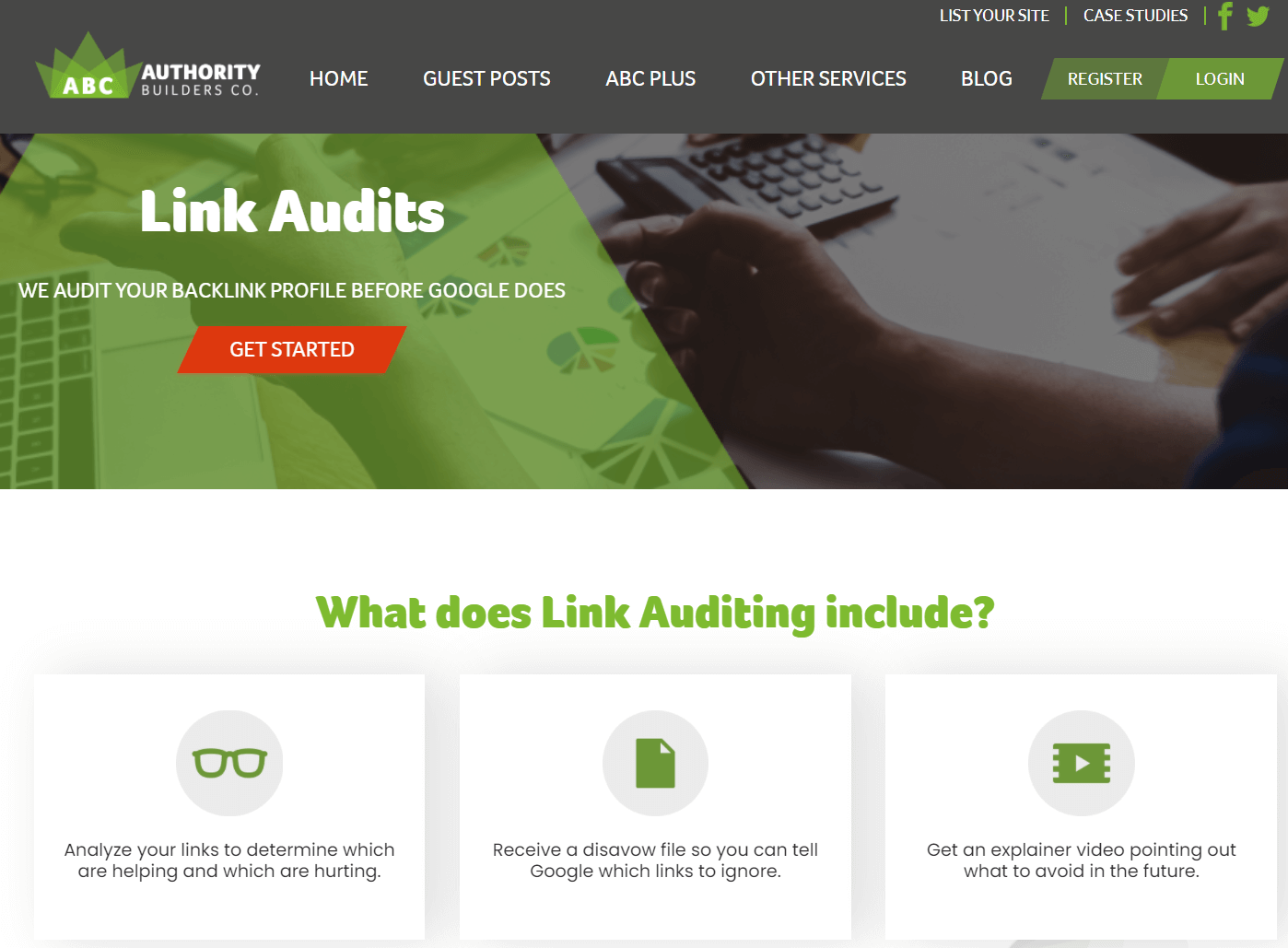
The link audit includes a full review of your website's backlinks (using data from Ahrefs, SEMRush, and LinkResearchTools), a disavow file - this tells Google which links you want them to "ignore", and a explainer video.
I definitely felt I could benefit from a link audit, given my current situation, but I really didn't know much about doing a link disavow.
After doing a bit of research (mainly reading the guide by Ahrefs here), I learned that disavows are usually reserved as a last-resort as doing them can actually harm your website since you might be removing links that were passing decent PageRank to you.
However, the clearest indication for a disavow is either a manual penalty (Google basically blocks your website from search results) or a massive algo hit (which is the category I'm in).
Now that I've decided to do a link audit & disavow, the only question was whether to pay for a professional link audit ($297) or do-it-myself.
The fee wasn't too bad, compared to the money I've been throwing at paid guest posts, but I ultimately decided to DIY and learn more about the link audit process.
I read through Rick Lomas' FAQ page and it seems the main data source for his report comes from LinkResearchTools (LRT), a specialty SEO tool for link analysis.
Fortunately, they have a $7 trial for 7 days so I signed up and ran their Link Detox Smart and this is what happened:
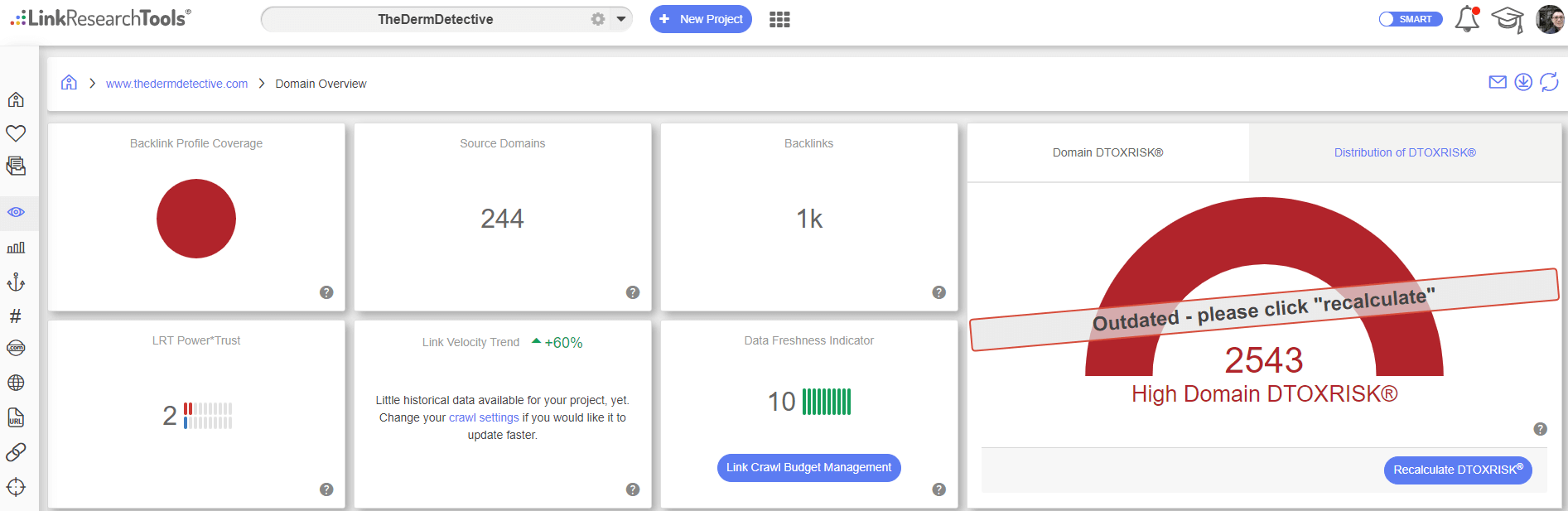
The tool calculated a huge red DTOXRISK score (their proprietary grading system for spamminess).
Actually, my original DTOXRISK score was even higher, like 3600+ (LRT says that anything over 1,000 "very likely causes a link penalty 😑 source: LRT).
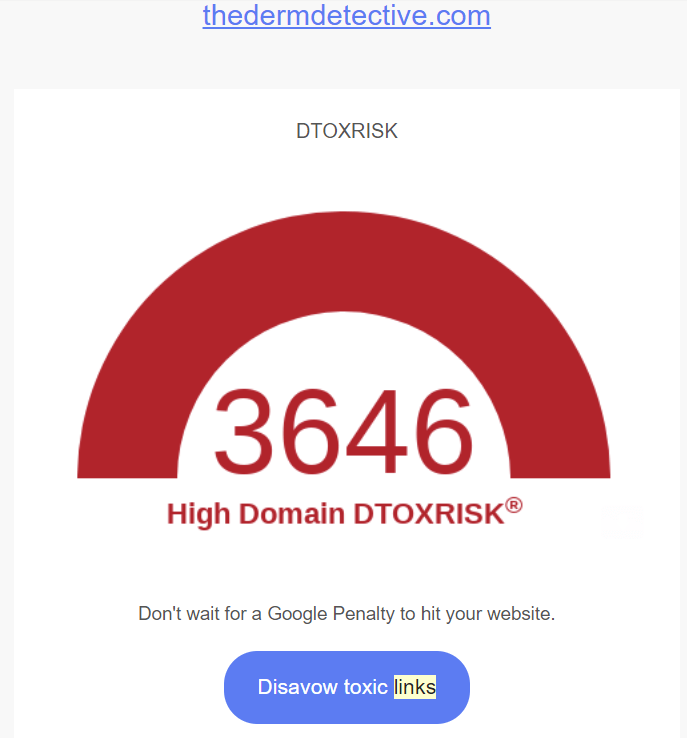
By the way, I also checked SEMRush's domain toxic score and it's pretty high too:
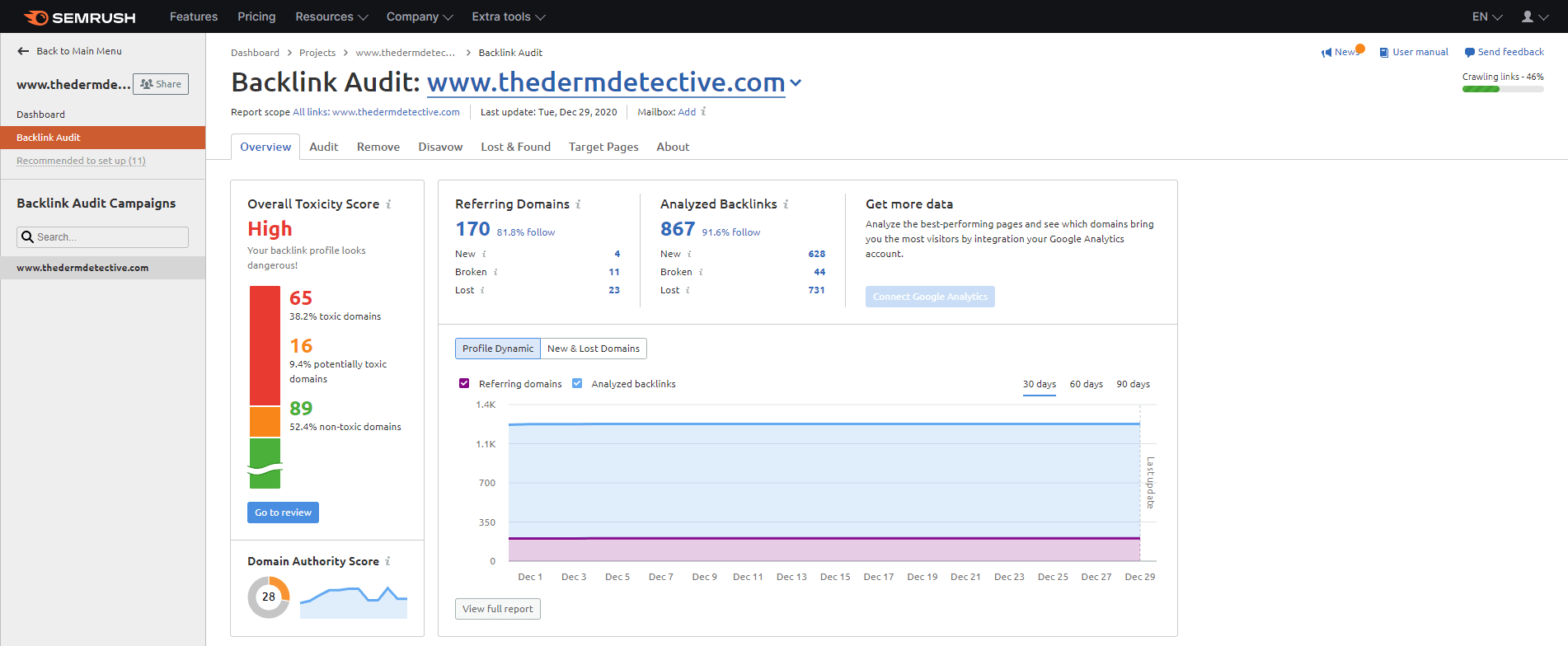
Okay, so I was a bit surprised at how "toxic" my link profile was, but after reviewing the "suspicious links" (btw, LRT organizes them very nicely based on DTOX score, whether the domains returned a 400 or 500 error, whether the domain has a PBN footprint, and a ton of other metrics), I discovered that the culprits were spammy websites that were scraping my content or images, often providing a "money" anchor text.
In fact, there were lots of similarities across the spammy websites, including:
- Country Top Level Domains (CTLD): some CTLDs are more likely to be spam because you can get a free domain on certain extensions. For example, the most common ones in my link profile were .tk (Tokelau), .ga (Gabon), .cf (Central African Republic), .gq (Equatorial Guinea), .ml (Mali), .pw (Palau), .info and .xyz (common with spammers)

- Gibberish Domain Names: essentially, if you can't pronounce the domain name, it's probably spam because the domain names were likely auto-generated by software. It was actually kind of fun trying to pronounce some of them.
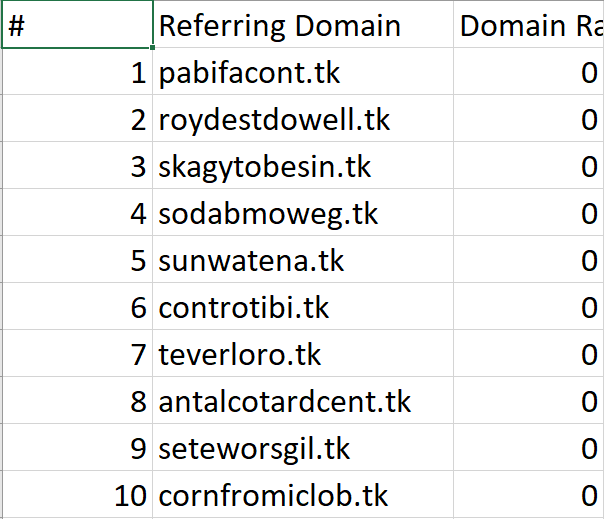
- Identical Pages or Anchor Texts: another clear pattern was that the pages or anchor texts were identical across multiple websites, an obvious sign of content scraping.
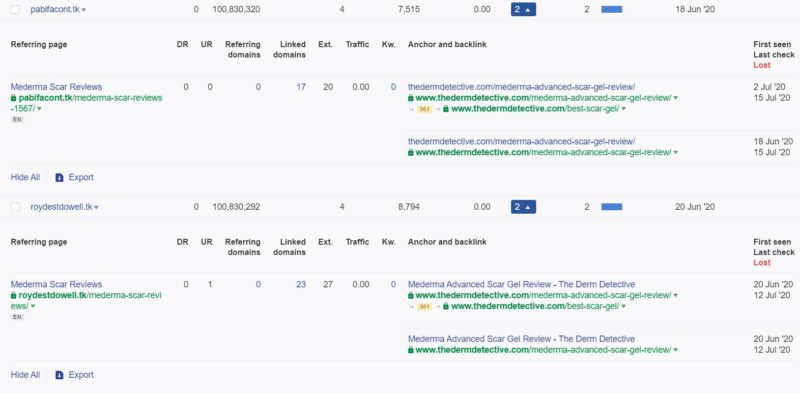
- Excessive Number of Inbound Links: in some cases, a domain was sending me 50-70 backlinks from several pages which is a big red flag. A normal editorial link should only be 1-3 links (as sometimes the same link is crawled on a category page or even the home page)
Now, I've also been trying to understand why I got these backlinks in the first place (there was a mix of dofollow and nofollow). For the most part, the links were placed on pages that were clearly scrapped using some kind of software program.
Here's how I would categorize the spammy websites:
- Website Does Not Exist Anymore: I had a ton of links from domains that don't even load anymore (as in the home page returns a 5xx error). Mostly .tk domains.
- Image Scrappers: the linking page contained hundreds of images and no content
- Content Scrappers: not as frequent, but in some cases I saw clear signs that they copied my content, including "related" links, or using my brand name in the title
- Keyword/SEO Scrappers: these might not be harmful, but there were a few keyword research tools with auto-generated pages analyzing keywords that I was ranking for (which is why I had a backlink there)
- Coupon Websites: again, might not be harmful, but a lot of backlinks came from different coupon/promo pages that scrapped parts of my content where I say something like "get 20% off with my coupon code", etc.
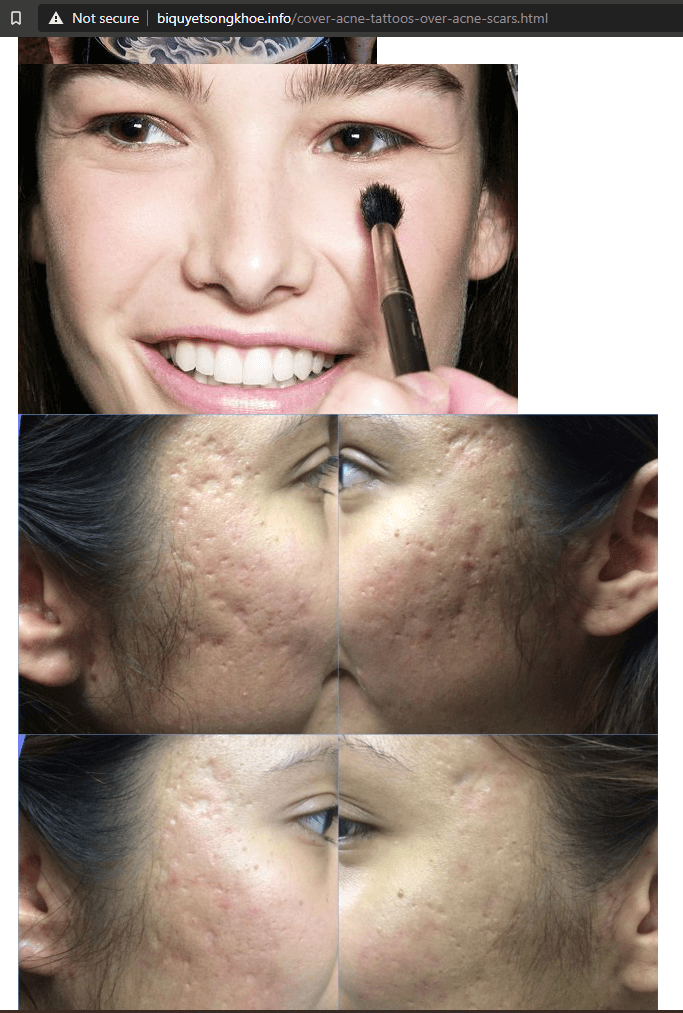
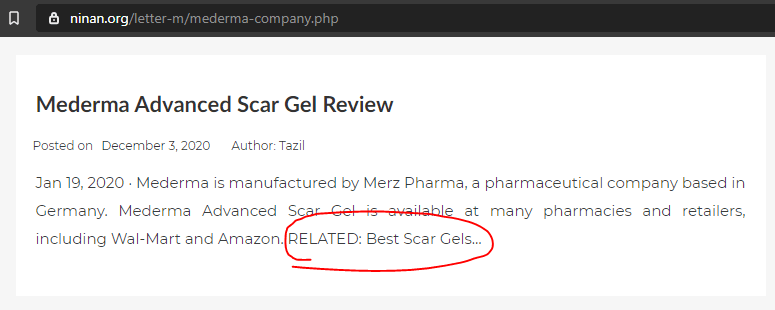
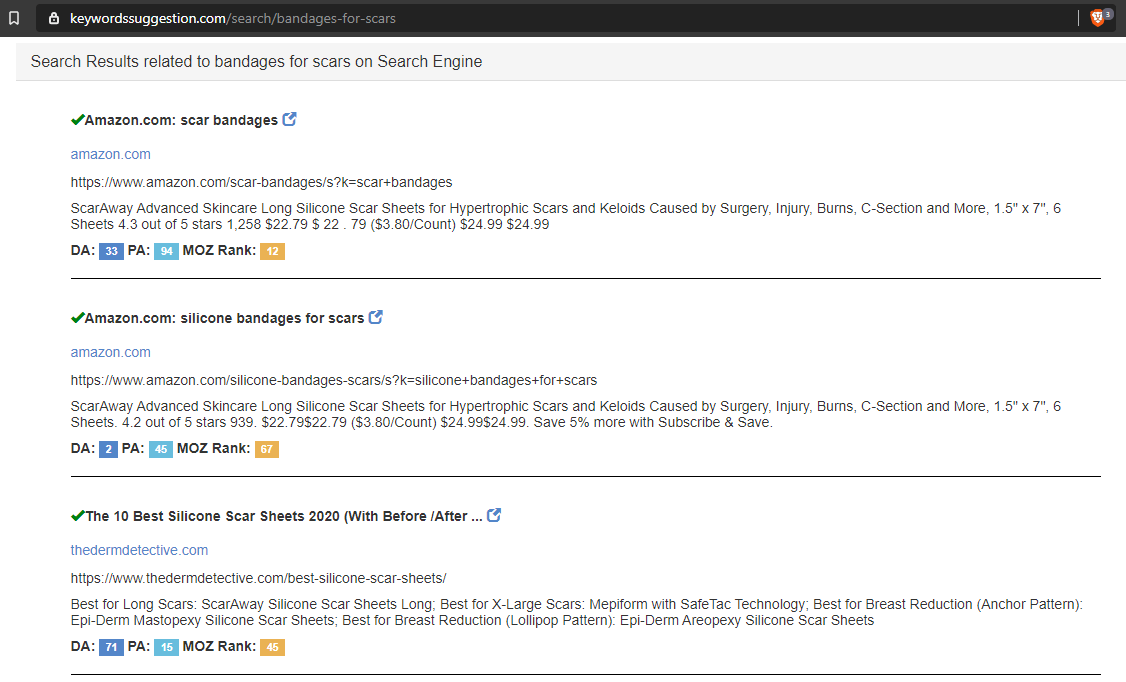
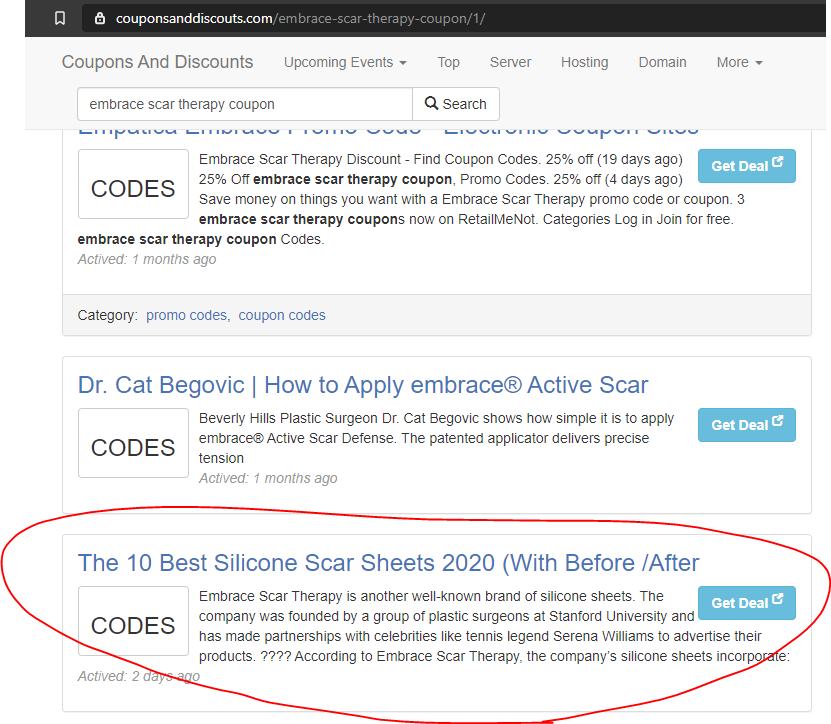
In any case, I manually reviewed each domain and 99.9% of the time, decided that it was spammy enough to warrant a disavow. This took a few hours because, unfortunately, LinkResearchTools does not allow you to export the disavow file with their trial version.
SEMRush and Ahrefs both allow you to create and export a disavow file, though.
SEMRush actually has a very good link audit tool that looks at similarities between bad links including identical pages, titles, file paths, Google Analytics ID, Google Ads ID, etc.
In total, I disavowed 354 domains and submitted it to Google Search Console.
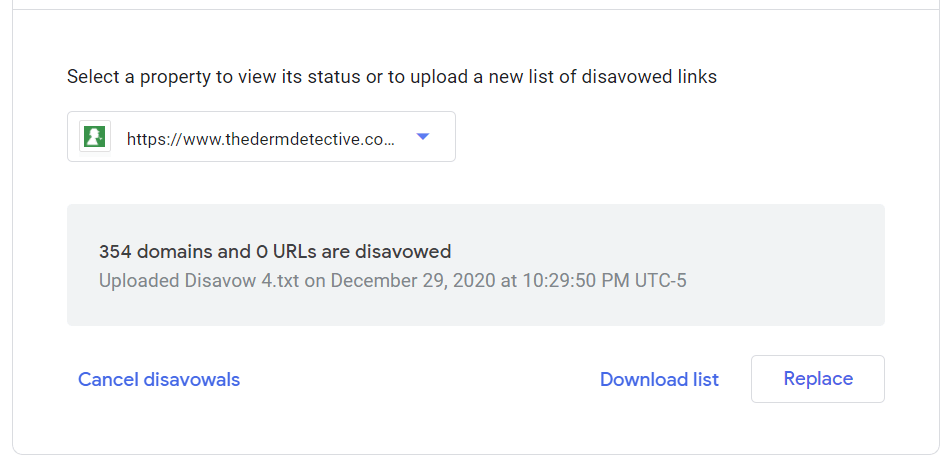
I know, it sounds like a LOT, but there was just so much SPAM there.
The other reason is that my website has been up now for 2 years and I've never done a disavow before so these types of links have been accumulating in the background.
I've actually noticed many of them in the past on my backlink profile in Ahrefs but never thought to disavow them (due to the risk of harming yourself with a disavow).
Now, a disavow file can take a few weeks for Google to process and then recalibrate so if there's going to be any impact, I should see those come in around February.
If I don't see a recovery by then, I'd also consider disavowing my paid guest posts as some of them (not all) were flagged by LRT as suspicious with high DTOX scores.
At this point, I think it's worth discussing the possibility of a negative SEO attack.
A negative SEO attack is when (usually) a competitor sends a bunch of spammy backlinks and over-stuffed anchor texts to your page, in hopes of getting Google to lower your rankings and effectively increase their own rankings.
Now, Google says that you shouldn't worry about negative SEO because they "take care of it" by devaluing the spammy links so they don't pass any negative effects to your website - however, some SEO pundits are not convinced this is true.
Personally, I don't entirely believe that I was targeted by negative SEO, frankly, because my website is very small so it doesn't seem logical for someone to target me as they'd have to spend resources (money & time) to send bad links my way in the first place.
However, most of the spam links were directed at a handful of pages, rather than being evenly spread out. For some reason, certain pages were targeted by the scrapping software - it could be a coincidence (due to their keyword selection process for creating the auto-generated content) or it might suggest an intentional attack. 🤔
Next Steps
Whew, this is a pretty long blog post already. Thanks for reading through it!
At this point, I'm cautiously optimistic that the changes I've made, especially the link audit and disavow process, will restore at least some of my original traffic.
Part of the reason I remain hopeful is that my rankings did not completely tank following the algorithm update. In most cases, I lost traffic because I went from #1-3 for a high volume keyword to #9-10 or back to page 2.
That tells me that Google still thinks my page is very relevant, but just doesn't have enough of the other factors (domain authority, etc.) to rank at the top of the SERP.
In 2021, I plan to continue building high-quality content (especially using Lasso displays) and execute a more comprehensive link building strategy to build domain authority.
My goal next year is to build $2,500-$3,000/mo of income, of which $2,000 will come from my current website, and $500-$1,000 from my second website (which I'm currently researching).
Even though I've had a disappointing end to 2020, I take comfort in the fact that I was able to achieve my target of $1,000/mo (a level that I feel is significant enough to demonstrate the potential earnings of this business) in 3 months out of 12.
Despite two major setbacks (Amazon & Google), and a worldwide pandemic, I genuinely believe that I've been building my business back better after each obstacle:
- In the case of Amazon: diversifying into private merchants and other retailers for increased profitability (I don't think I'll ever go back to Amazon, TBH)
- In the case of Google: cleaning up my links, improving content quality and page speed
I also believe the experience that I've accumulated in this process has been both rewarding and will be extremely useful for the future.
If I launch an ecommerce store or join a tech startup later on, these foundational SEO skills and general understanding of websites and the Internet will be very helpful.
To a prosperous, healthy, and successful 2021! 🎆
Tom
Welcome back to Flexibility Is Freedom!
Is it just me, or does it feel like the part of the movie where you've already watched enough to know the ending? (either that, or you need to run to the bathroom 🤣)
Yeah, 2020 is almost over but we still have one more month to go...
In any case, the holidays are a time of celebration, gift-giving (including self-gifts 🎁), and spending time with your family (although, I think we've all spent more time with our family, roommates, or significant other than we could have imagined this year).
Anyways, let's cut to the chase - in this post, I provide a summary of November performance for TheDermDetective.com, my Black Friday & Cyber Monday activities (including an experiment with Pinterest ads), and my plans for next year (including 1-2 new websites and a YouTube channel about passive income - check it out here).
Key Metrics
- Revenue: $1,143 (-8% MoM, +545% YoY)
- Sessions: 10,580 (-1% MoM)
- RPM: $108 (-7% MoM)
- Amazon Risk*: 39% (down from 43% last month)
Overall, November was another excellent month, all things considered.
Business performance was very similar to October with nearly identical levels of traffic, but slightly lower revenue and profitability (RPM).
While Black Friday / Cyber Monday does fall within November, the effects, if any, will either not be very significant or will impact December more (because Amazon Associates credits the sale when items are shipped, not when they are ordered).
Speaking of Jeff Bezos the Devil, I'm happy to report that my dependence on Amazon has decreased to 40% (from 44% last month), marking a 50%+ reduction from 85% at the start of 2020!
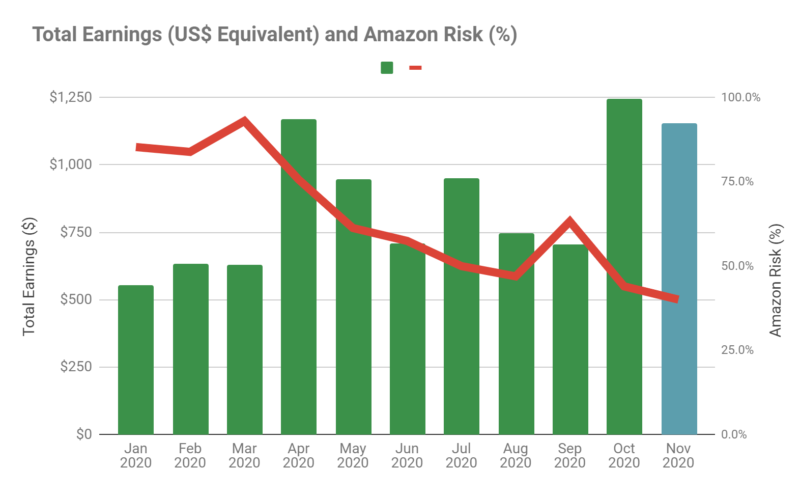
On the traffic side, sessions stabilized around the 10K mark after consecutive months of declines since May 2020 (driven by a conscious decision to eliminate lower performing "vs" and some "review" posts with low conversion rates that, coupled with Amazon's new commission rates in Health & Household (1%) and Beauty (3%), made these posts very unattractive to maintain).
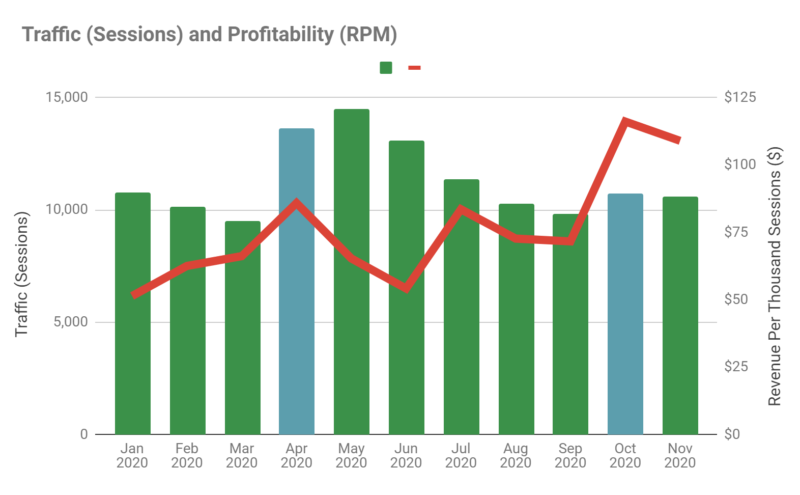
On the profitability side, I'm very excited by positive trends in the last two months, which I believe reflect a new content format for "Best" type posts.
Let's dive into that now!
New Content Format = Conversion Heaven
In October 2020's Income Report, I mentioned near the end that I was piloting a new content format for "Best" posts to replace my existing templates.
In particular, the new format is cleaner, simpler, and less complicated than the old one.
The TL;DR is that this new format has led to conversion rates of 65-75% compared to only 50-60% with my old content templates.
To refresh your memory, here's an example of the new format:
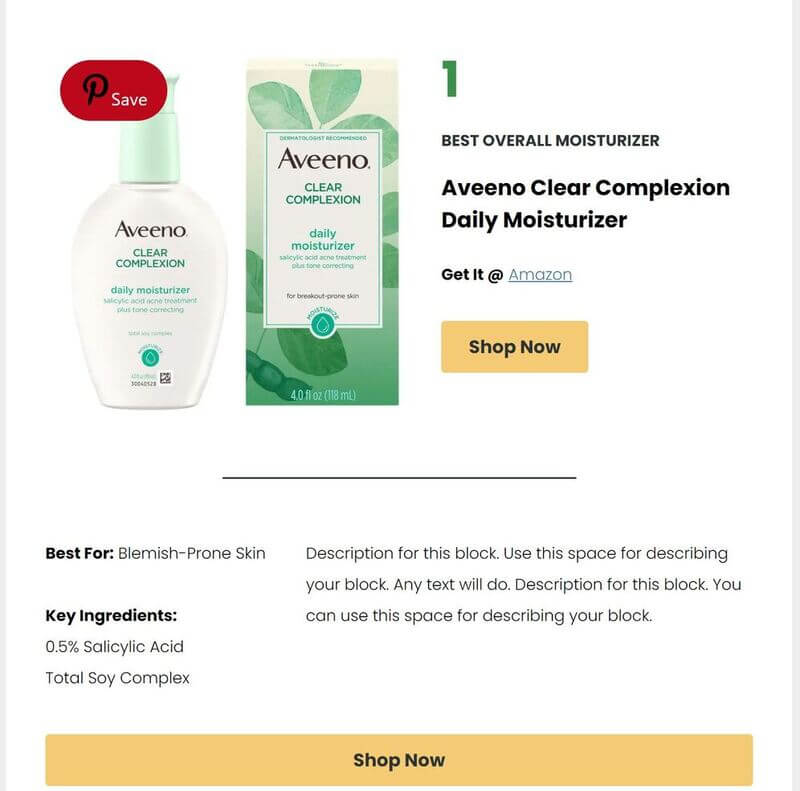
In this new format, users can convert in 4 different locations:
- Product image
- "Amazon" text link
- First "Shop Now" button
- Second "Shop Now" button
- Additional text links in the product description
Now, here's my old content template. Note that the image is not clickable (due to the restrictions of a particular block I was using from Stackable).
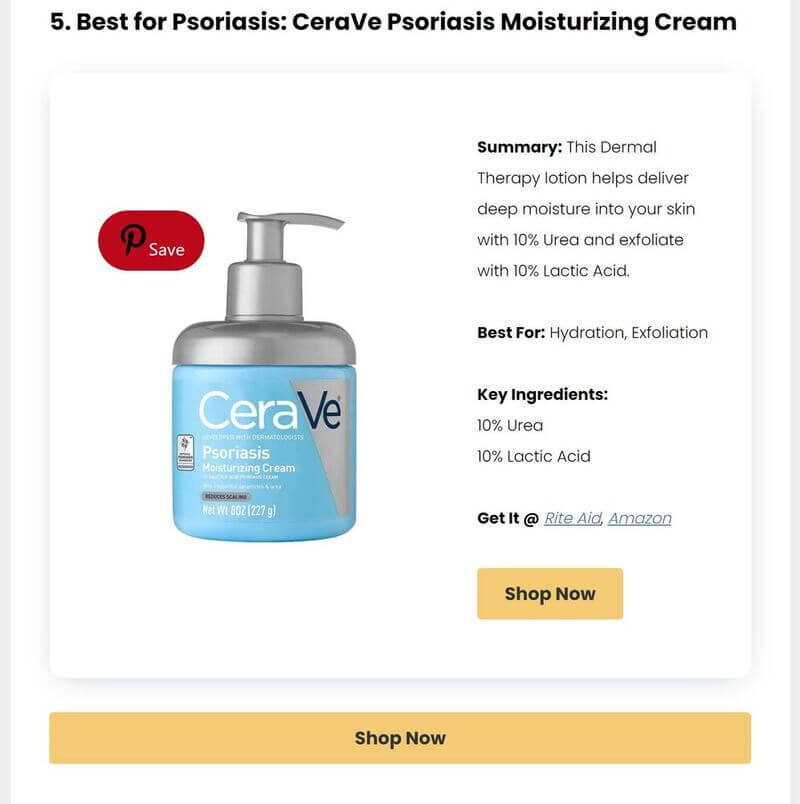
In addition, I optimized the mobile design of the new format.
Okay, so here's the actual data I've collected:
- In the chart below, I've included the conversion rates of 5 posts, A & B were either created or upgraded to the new content format in November. C, D & E are 3 of my best performing posts that currently still use the old format.
- Conversion rate is defined as: unique affiliate link clicks (tracked via Google Tag Manager) divided by unique pageviews (tracked in Google Analytics). One drawback of this method is that it does not measure if a user clicks on multiple links as we are using unique clicks and unique visitors instead of gross clicks/visitors.
- As you can see, A&B outperformed C, D & E in November (65-75% vs. 50-55%). However, I should mention that in previous months, conversion rates for C, D & E were higher at mid-to-high 60% level but have since decreased for some reason.
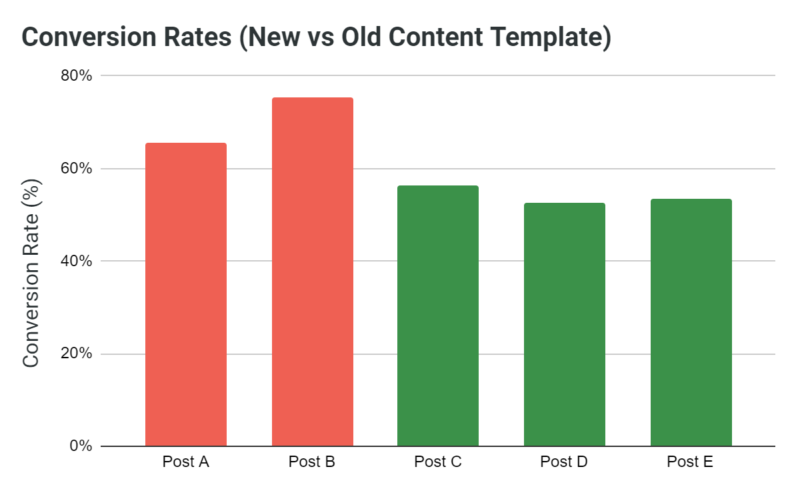
Based on this observation, I'd say the new content format was a huge success and I will be slowly rolling it out across my old posts when I upgrade them.
Black Friday & Cyber Monday Activities
Ahead of Black Friday, I decided to try capturing some delicious holiday shopping cookies which I believed would be worth more than usual. I ran a small experiment with Pinterest ads (expensive!) and did a lot of shopping myself to scale my business.
My Attempt to Capture Holiday Cookies 🍪
When you think about affiliate marketing, you typically think of referral sales, online marketing, third-party advertising, etc.
But when you boil it all down, it's about getting your affiliate tracking cookie onto someone's browser and hoping/praying that they make a qualified purchase within the time limit.
That's the name of the game! (coupon sites know what I'm talking about 😉)
So it seemed to me that the best time to get a cookie on someone's browser would be during the busy holiday shopping season.
My strategy was to create a holiday gift guide for skincare products - promote it to existing visitors using OptinMonster pop-ups, a nascent email list, and Facebook / Pinterest ads.
After creating a massive gift idea post (50 Best Skincare Gift Sets), I setup OptinMonster, sent my email subscribers an update, shared it on Facebook/Pinterest, and waited.
The result? Not a peep. 🤣
Let's start with OptinMonster: they charge you a fortune for their service (to be fair, they have some amazing features and customization options), but you don't actually end up getting too many leads out of the footer bar and pop-ups.
In my experience, I ran desktop/mobile campaigns during the BF/CM weekend and barely got 5 or so conversions across all campaigns.
OptinMonster makes more sense for capturing high-value leads (like customers for SEO services) where it helps you squeeze out incremental leads with exit-intent pop-ups. So I returned it and I'm back to using Beacon lead magnets again (I bought the lifetime deal earlier this year).
My email list and social media audience are both limited so neither provided meaningful traffic.
Although my Facebook page has 100+ followers, I find my posts rarely get likes or comments.
Pinterest Ad Experiment
Seeing as none of my organic strategies worked very well, I ran a Pinterest ad campaign.
I figured that Pinterest was a great fit with my audience (70% women, 50% under 30) and that clicking on ads felt more organic on Pinterest compared to Facebook.
I ran a simple campaign with 4 ad groups:
- Keyword-focused: 2 ad groups targeted specific keywords and would only fire if a user was using Pinterest's search function
- Interest-focused: 2 ad groups targeted people with skincare interests and would only fire on the user's home page (browse) and related pins
Here's a summary of the ad campaign results.
In total, I spent $60 USD to acquire 41 clicks (CPC: $1.46) and 12,479 impressions (CPM: $4.80). The ads also resulted in 3 saves by Pinners (which can lead to free organic traffic).
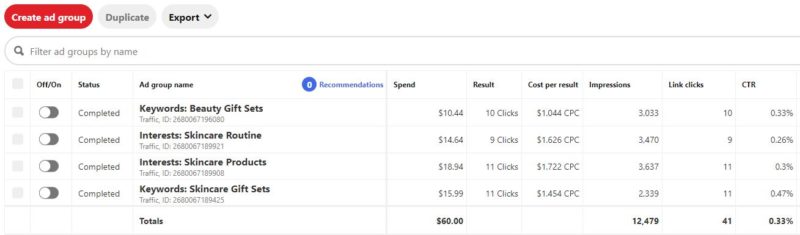
It was the fastest money that I've ever spent (and I didn't really feel like it was worth it).
But it was still a good experiment to run.
I ran the campaign on Thanksgiving Thursday and Black Friday and it ran out of money (I set a budget of $60 and $20-$25 caps on each ad group) by Friday evening.
Strangely, even though Pinterest says they delivered 41 clicks, Google Analytics only recorded 3 visits where the referral source is Pinterest.
Moreover, a total of 22 pageviews were recorded on Thursday/Friday, only half of the 41 clicks.
There's likely some additional analytics setup needed to properly track the Pinterest referrals correctly (I do have the Pinterest tag in Google Tag Manager already).
After running this campaign, I have a much better idea of how expensive running ads are for merchants and brands. It really feels like you have to "pay to play" and most of your initial spending is literally to get market data on keywords and demographics so you can fine-tune your ad spend and achieve positive ROI or ROAS.
Unfortunately, this is not something I have the budget for right now. In addition, as an affiliate, I cannot track the user from referral (Pinterest) to sale (at the merchant) due to the limitations of different affiliate networks and merchant's technology. If I operated my own online store, however, this could definitely be done and then I can optimize ad spend based on which users were actually making purchases on my store.
Another idea that has come out of my Pinterest ad experiment is the idea of cost parity across marketing channels. That is, in theory, running ads to generate sales should cost about the same as paying an affiliate to bring in a sale, in a competitive environment.
For example, if I have to pay $1.00 per click and it takes 10 clicks to generate 1 sale, my effective cost per sale is $10. If an affiliate brings me that sale, I should pay them $10 since it's the equivalent of running 10 x $1.00 CPC ads.
This presents an interesting theoretical model for an affiliate (or affiliate manager) to assess whether they are being paid (or paying) fairly compared to the market rates. You could take the advertising CPC of relevant keywords for the brand (or perhaps the CPC of the keyword that is driving traffic to your post) and compare it to the average commission that you receive per order (commission rate * average order value). Then evaluate whether the implied conversion rate is reasonable or not for that brand.
For example, here are the numbers from a brand I'm working with:
- CPC of Brand Keywords in Google: ~$0.60
- CPC of My Target KW: ~$1.30
- Avg. Commission Per Sale: ~$5.00
- Implied Conversion Rate (Brand KW) = $0.60 / $5.00 = 12%
- Implied Conversion Rate (Target KW) = $1.30 / $5.00 = 26%
- Actual Conversion Rate (Based on My Traffic Sent) = 4-5%
Based on this analysis, I could argue that I am being paid less than market price compared to the cost of running ads in Google. Supposing that the brand does convert at roughly 4-5% (this really depends on the traffic quality), it would cost them $12.00 for each sale using branded keywords and $26 using my target keyword, whereas I deliver them a guaranteed sale for only $5.00 (15% commission rate).
The point at which equivalency is reached would be if the brand can achieve 12% conversion rates with their ad campaigns which makes them neutral to getting a sale from ads or from affiliates.
Perhaps I will try using this model to "persuade" affiliate managers to pay me more in the future. We'll see how that goes.
Appsumo Mega Purchase
Lastly, I made far too many purchases on Black Friday, mainly for lifetime software deals from Appsumo to further scale my business. Here's the damage:
- Hexowatch: automates page checks for visual, HTML, technology, WHOIS changes. Great for monitoring competitor webpages, pricing pages (for deals or track competitors), and many other applications. I stacked 3 codes for 25,000 monthly checks - this should be enough to scale with my 2nd and 3rd websites. Combined with SERPWatch (rank tracker), I can now monitor how SERPs changed and what exactly changed on the competitor's webpage.
- Frase: AI-powered content research tool. Kind of similar to Copywritely, which I bought last year and didn't use too much. Frase seems to scrape the top 20 Google results for a given keyword, parses it through their ML/NLP algorithm and spits back a summary of key topics, statistics, sources, links, average word count, etc. I'm going to try using this tool to write my future content pieces and create content briefs for outside writers (that is the main strength of Frase).
- BigVU & ReMasterMedia: two tools for helping me create video content. BigVU is a video teleprompter and recording software which I can use on my phone to create slightly more engaging videos than my current screen recordings. RMM is used to remaster audio files for better sounding videos.
- Publer: so this tool is supposed to help manage/analyze all social media accounts in one place, but I've found that it doesn't fully support Instagram and Pinterest yet. Also, I can post my Instagram photos automatically to my Facebook page and Twitter account, so I'm not sure what value this tool will actually have in my tech stack. Still, the reviews were amazing so I'm going to dig deeper to see how I can use this one to grow my social media traffic (one of my key goals for 2021).
- InSignal: a cheap alternative to Hotjar (heatmaps, user screen recordings). If it turns out to do 50% of Hotjar, it's already worth the price ($49 lifetime deal).
- Appsumo Plus: I finally plunged on Appsumo Plus, their premium membership. Mainly because I save an additional 10% on my Black Friday order, which makes the membership only about $30 extra. It comes with free KingSumo Plus which is a software tool for running giveaways to increase email subscribers (something I'll try on my site soon).
Migration to Cloudways (Adios, Siteground!)
And my last Black Friday deal was getting started with Cloudways, a managed hosting company that was recommended by a few Facebook groups and websites. Back in September, I was very frustrated with Siteground due to how they handled and treated my website due to a plugin's malfunction which caused a huge server overload.
I have also noticed in the time that I've been with Siteground that there are occasional 500-level server errors and Google Search Console even alerted me about such an instance once. This is the most concerning problem for a website to have...
Although I do believe that Siteground is still quite good, for the price you pay (I paid $214.20 for 36 months or $5.95/mo), I know that it's past time for me to move to a managed host where I have more control over the website's allocated resources which should result in a faster and better user experience (and no complaints from Google, hopefully).
First, I have already migrated F is F to Cloudways, pending a change to my nameservers at Cloudflare. That will give me time to test out Cloudways (which is only $10/mo for their cheapest plan) and fix any bugs before migrating TheDermDetective.com.
I'm cautiously optimistic about this move, but I know from past experience that migrating a website, especially a money website, is a painful experience and you should expect at least a few hiccups and problems (like my migration to Kinsta early this year, which I then cancelled and switched to Siteground instead).
Next Steps
Looking back on this year, I'm proud that I was able to overcome many hurdles, particularly the Amazon Associates rate cut, and eventually achieve my target of $1K/month (this was a goal I originally set in 2019 which was deferred to 2020).
In many respects, the Amazon event was a net-positive in the long-run because it forced me to diversify towards alternative merchants where I eventually came across much better paying and converting programs, especially on the private side. Today, some of these merchants generate as much commissions as my entire Amazon account, but with far less traffic and fewer orders.
It's made me realize that with the right partners/programs and high-converting content formats (as we discussed earlier in this post), you can generate a respectable amount of revenue off of lower volume keywords that competitors may not be looking at. This really resonates with me as I've seen in the last 1-2 years of ranking for certain keywords that new competitors will come into the market or existing high DR competitors will write about your topic and in one case, competitors will just steal most of your content (probably their writers, anyways) and outrank you. This makes SEO feel like a hamster in a wheel, constantly running to stay in one place, not quite the passive or semi-passive stream of income that I had envisioned for this business.
For 2021, my overall goal is to reach $2,000-$3,000 of monthly income with TheDermDetective.com, via continued content creation, optimization, backlink purchases (and eventual organic outreach campaigns), etc. plus another $500-$1,000 from a new website (or two) that I will start building next year.
If I can achieve these two goals, I think that sets me up nicely to move more into the portfolio management position and outsource more of my writing/editorial and technology roles to writers, VAs, and perhaps a part-time employee.
For my new websites (or digital assets, as they will include social media accounts and other forms of value like backlinks, brand relationships, etc.), I'll be recording my steps as I go on my YouTube channel in a free online course (see my playlist here). I don't have aspirations to become a YouTuber but hope that interested people will find my videos and potentially follow them to create their own passive income businesses.
For my next venture, I do want to make sure that I learn from my mistakes and explore new avenues of growth in the digital marketing space:
- Industry/Niche: I will most likely NOT be doing another health/fitness/beauty related website given i) I already have one, and ii) industry-specific headwinds for small businesses like Google's 2018 Medic Update (known as E.A.T. in the industry) which favored larger, more reputable websites like Healthline for health queries, iii) low commission rates for health products on Amazon (1% Health & Household), and iv) gross oversaturation of this industry/niche by bloggers and affiliates
- Monetization: I would prefer to monetize 90-100% outside of Amazon's ecosystem, if possible, otherwise, I am willing to accept something like 25% maximum exposure if there are really good alternative programs. So maybe in the outdoors niche, you promote 25% Amazon and 75% REI and niche outdoors merchants.
- Profitability: in my experience with TheDermDetective.com, I've seen merchants with EPCs in excess of $100 per hundred clicks - effectively $1.00+ CPC, so it's almost like you're getting paid for every click. I would like to find similar paying/converting merchants with high EPCs (say $80+) so that I don't need as much traffic to create the same level of earnings. This is especially important where the industry/niche is very competitive and it's difficult to rank or to maintain rankings.
- User Engagement: much of what makes a "niche" a niche is the characteristics of the target audience and how engaged they are (more engaged = more likely to purchase online or sign-up for newsletters, etc.). Skincare is actually a decent choice here as people typically want to get rid of a skin problem or they are a "skincare enthusiast". I want to make sure I've found a target audience who has urgency (time is of the essence to an extent), agency (they make their decisions themselves), and proficiency (they understand what they need to do to an extent).
- Social Media? With TheDermDetective.com, I really haven't dived much into getting social media traffic and measuring the conversion rates of that audience. In a world of more "Tik-Tok" and browsing/discovery channels (like Google Discover), it's also important to stay on top of these massive sources of traffic, in addition to SEO.
- Products/E-Commerce: in the long-run (say 5-10 years), I feel that affiliate marketing will continue to decline in terms of attractiveness/profitability, as Amazon has made clear to many affiliates. Part of the value from affiliates is their ability to deliver sales on 100% commission (no sale, no commission). However, as merchants, especially the big ones like Wal-Mart/Target, etc. get smarter at optimizing their digital marketing efforts (via ads, social, SEO, direct, etc.), the need for affiliates will generally decrease and this will be reflected in reduced commission rates. On top of this, we should also consider the ever-expanding inventory of digital "real-estate" - Google ads, social media, the next Tik-Tok, apps (build-in advertising). Unlike real real estate, digital real estate can be created with 0 marginal cost - it just requires a user to search or browse. This expanding inventory will eventually reduce affiliate profitability as well since the two are direct competitors as marketing channels (and should be equivalent in a perfectly competitive market). So the solution, then, is to expand beyond affiliate marketing and offer my own products/services which would have higher margins, opening the way to ad campaigns and more expensive marketing channels.
- Brand: perhaps above all else, I believe that what makes a digital asset successful and sustainable is a defined and memorable brand in the eyes of its target audience. It sounds obvious, but in the online world, there are (practically) no geographic boundaries to competition (as with local bars, restaurants, barbers, etc.). When you remove these limitations, you will find that the best performers (say the top 10%) will attract the majority of the attention/revenue/opportunities (say 90% of everything). This is because there are no logistical/geographic constraints to prevent the "best" from serving everyone who is interested (unlike an expensive restaurant that requires reservations months in advance). If you do not create a brand that can hold its weight with your audience (we call this "influencer marketing" and such these days), you may end up having to compete on price and then it's a race to the bottom where the cheapest product/brand wins (you see this with many Amazon products, especially in the technology sector). So in summary, I'll be looking at opportunities where I believe I can create a brand from scratch, start in affiliate marketing and potentially move into e-commerce, distribution, or wholesale in the future.
Thanks for reading my income report and stay tuned for December's annual review!
Stay healthy and feel free to drop a comment below.
Until next month,
Tom